
Excerpt from the article:
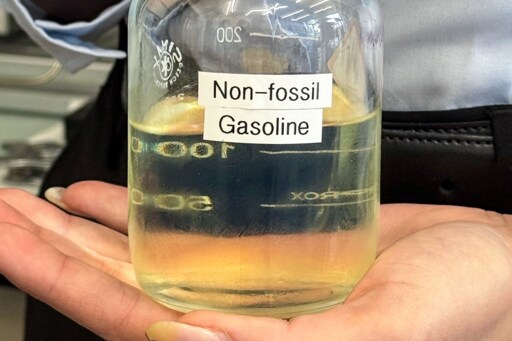
Millions of combustion engines – powering machines, vehicles and aircraft – will remain in use for decades to come. Instead of replacing them, a Swiss chemical engineer is developing a greener alternative: a synthetic, “drop‑in” fuel that works with existing engines and infrastructure.
Inside her labyrinthine lab at the Swiss Federal Laboratories for Materials Science and Technology (Empa) in Dübendorf, a network of pipes and custom-built modules hums away as Alessia Cesarini shows off the prototype e-fuel unit she took two years building.
She aims to turn it into a business offering a viable alternative to conventional fossil fuels.
“There are lots of systems with combustion engines still running, and the idea is to provide a locally produced and less-polluting solution,” she explains.
Transport accounts for 47% of Switzerland’s energy-related CO2 emissions, versus 25% globally. A Swiss study estimates that around two million combustion-driven vehicles will remain on the country’s roads by 2040. Globally, Bloomberg estimates that 55% of cars will still run on combustion engines by that time. Also, for hard‑to‑abate sectors such as aviation, long‑term decarbonisation will depend heavily on the adoption of renewable fuels.
Cesarini’s approach is simple: “The goal is a solution that works with existing vehicles and infrastructure – sustainable both environmentally and economically,” she says.
I am curious about the costs of this fuel. At the moment, electrification of traffic is cheaper and easier in most sectors and synthetic fuels are prohibitively expensive. Also, CO₂ emissions from burning fuel is not the only problem with our current traffic system, congestion, particulate matter and noise are huge issues, too.
We need to reduce individual motorised traffic (too many (and too big) cars with only the driver in it), improve and expand public transportation, walkability of cities etc. But for sectors where these measures and transformations are not feasable or even possible (like air and ocean travel and cargo), alternatives like synthetic, emission free fuels are badly needed.Technically it won’t be emission-free. The idea is to derive synthesized fuel from captured CO2. The CO2 will be re-emitted when the fuel burns.
This research does not address the carbon capture part of the cycle, just the fuel synthesizing part.
But she does end saying its realistically a 90-95% reduction in emissions
But theres no clarification on whether that is just what is emitted from the exhaust of the vehicle or if its the production of this “e-fuel” or if its both or something else entirely
Which emissions? It’s a hydrocarbon, it will make C02.
If people want clean burning fuel from renewable sources that can be made anywhere, see ethanol.
Net emissions. If the fuel is made from captured CO2, there may be some loss in manufacturing but it won’t be nearly as emitting as the current process of extracting and refining virgin oil into petrol.
Hopefully I’m wrong, but I think a lot of the carbon capture stuff will either be pipe dreams or scams.
Hopefully I’m wrong, but I think a lot of the carbon capture stuff will either be pipe dreams or scams.
Keep in mind, people said this about both wind turbines and solar panels in the 90s, that they would never be efficient enough to be worthwhile, that they were just money pits and the people taking government money to develop prototype projects were scammers.
My impression is that it is usually a very different group of people saying carbon capture is an impractical solution to the people saying wind turbines or solar are a pipedream
My impression has generally been that folks with expertise have felt like carbon capture is an impractical moneysink, vs climate change deniers trying to say the solutions presented could never work
But perhaps I am wrong and there is a meaningful body of experts who thinks carbon capture is an important and viable tool, and/or have been a meaningful body of experts who thought wind power or solar would never have promise. I’m not the most knowledgeable on this subject
My impression is that it is usually a very different group of people saying carbon capture is an impractical solution to the people saying wind turbines or solar are a pipedream
Today, yes. In the 90s, not really. Solar and wind have benefited massively from government subsidies to develop out of the prototype stage and into proven effective technologies.
I’m not saying carbon capture is definitely effective, I’m saying there hasn’t been enough investment in the field yet to determine if it is or isn’t.
Without some means of effective carbon capture, this synthetic fuel project has no environmental benefit.
Capture is a lot less concrete, more nebulous and it’s harder to verify it’s happening. At least with today’s tech. A massive bait and switch has already happened with Canada’s program, which as it happens will only capture carbon which represents a fraction of the externalities of shipping it around.
will only capture carbon which represents a fraction of the externalities of shipping it around.
This sort of outcome definitely concerns me. Logistics costs are so often overlooked until after they become relevant.
The best outcome for a project like this would be some machine that could pull CO2 from the air and pump it directly into the fuel synthesizer, but I’m no chemistry expert, that could be impossible or too energy intensive to be worthwhile.
Ethanol is carbon capture.
“In general terms you can reduce your emission, based on which source you take, theoretically up to 100%,” she says. “More realistically, it will be around 90–95%.”
The “based on which source you take” part is referring to where the CO2 comes from. The emission reduction number she’s giving is for the whole cycle, not for the output of an engine burning the synthetic fuel.
This is what they wrote in the article
[…] and initial estimates suggest it could be cost-competitive with fossil gasoline once produced at an industrial scale.
I guess it‘s very vague and honestly I don‘t know anything about this field. The article just felt uplifting for me, hence why I posted it.
The way I understood is not to compete with the ongoing elecrification of traffic but to develop an alternative for the remaining combustion engines that will likely stay for who knows how long.
Maybe it’s a local thing, but here in Germany, the liberal party (FDP, neoliberals mostly) and others who do not want to make the adjustments necessary to limit climate change are pushing synthetic fuels (“E-Fuels”) and use them as an excuse to block any actualy effective measures.
Again, there are uses for such fuels, but they are very limited.
Even if it was a little more than normal gasoline, it’s heavily preferred by us. We don’t drive but if our bus d tickets get a little more expensive because of it that’s fine by us. We have preference to electric buses overall but if we need the gas buses then this would be a far better alternative
I agree. Might be a good thing for aviation and other sectors without a good alternative. But additionally it will be badly inefficient. Even if the production process is good, the best diesel efficiency factor is around 40%.
decarbonise
If your furel contains carbon, you’re not decarbonizing anything, you’re just changing the source where the fuel comes from.
You want decarboned fuel? Hydrogen, or you get to “just plain” electricity
The problem with carbon based fuels is that we’re unburying them and releasing carbon into the atmosphere which was sequestered under the ground for millions of years, a LOT of it.
If he’s taking solar power + CO2 from the air to make his fuel, then when he burns it it’s just a closed cycle system, at least no new harm done, just returning the carbon previously captured from the air in the process.
Synthetic fuels will never be competitive with renewables outside of specific applications, e.g. aviation. It’s simple physics. You simply can’t beat charging a battery from solar panels and then driving off. Putting multiple steps in between just makes it all very inefficient.
The idea (I think) would be for it to replace fossil fuels before EVs become the norm in places like the US. Considering orange man’s very clear goal to wipe EVs off the face of the country, I think this is an admirable goal but one that is misplaced as the real solution would be for the US to somehow get someone from the DSA, or even more left, in the white house.
The reason President Pedophile wants to block alternative energy is to enrich the people selling oil, so synthetic fuel doesn’t solve the critical problem: oil billionaires haven’t been eliminated yet.
Replacing fossil fuels with synthetic fuels is entirely infeasible. Building out the infrastructure at the gigantic scale required would take decades in the best case scenario. This stuff has always been a pipe dream and a diversion tactic. The real solution is renewable energy. The transition is currently happening and pretty much unstoppable at this point. The fossil shaggers are just trying to squeeze as much profit out of their obsolete technology as they can and they’ll literally rather burn the planet than give up a single cent.
Germany scaled the process up to nearly all their fuel needs in WWII.
No they didn’t. They created liquid fuels from coal. And it was ludicrously inefficient and unsustainable.
It was ludicrously inefficient and unsustainable. However it worked and scaled up. The process is still used today to make synthetic oil from natural gas. Any source of carbon can be used, coal is what Germany had.
That’s not correct.
I agree with you, but I was trying to frame it optimistically for our current fascist hellscape
I think the thing to remember about orange man is he’s always for sale to the highest bidder. So yeah, he’ll lie all day for fossil fuel ghouls so they can milk the last drops from their land, tool and infrastructure investments.
But at the end of the day, the sum of other industries is bigger than fossil fuel. They want cheaper energy and independence from fossil supply chain, and their lobbying dollars will overtake the fossil industry’s.
I’m hopeful it will be good for aviation. It’s pretty hard to compete with kerosene’s 46.2 MJ/kg. The best batteries today are around 300 Wh/kg in commercial use, and some labs have hit 700+ Wh/kg. But with a MJ being equal to 278 Wh, we’re still talking 20-50x the energy density by weight. And that’s before even talking about how chemical fuels that are burned off leave less weight behind for the remaining vehicle, whereas a discharged battery weighs pretty much the same as a fully charged battery.
Also, if we do move to storing energy in chemical bonds, pulling carbon out of the air, that basically turns into a carbon sequestration technique with whatever excess solar/wind energy we end up with, especially if we intentionally overbuild the capacity for non-peak production, and leave a method for using that energy during peak periods.
Hydrogen would be a much better form of power for long haul, at least for ships and diesel trains and trucks. By weight it is more energy dense than gasoline but volume is the problem, however for a big ship or a train it makes perfect sense. Point to point intermodal logistics hubs with hydrogen production at either end produced entirely by excess renewable during the day.
Set up one facility in LA and one in Shanghai for ships transiting between them and that could cut thousands of vehicles worth of emissions for every ship. Expand that out to train terminals, truck stops, and certain airports for the right flights - they’re all generally located in the same area anyways.
The problem is the cost of production, but the solution is having so much excess solar generation throughout the day that the cost to produce becomes competitive. Battery tech can always improve, but hydrogen tech is here right now and available today, and only really requires the right incentive structure. Just building out solar panels to lower electricity prices low enough could do that.
I’m pretty sure that’s the point of it, it’s not meant to be a broad solution, but a solution for the things it’s needed for
Europe is obsessed with the idea of green gas. This will take as much energy to make as it produces, and in the end, the same profile of combustion products.
Just burn ethanol.
Ethanol has too low of an energy density; it’s a bad fuel. The only reason countries dilute gasoline with it is because the inputs are so heavily subsidized.
Many countries run on pure ethanol. You’re just parroting gas and oil bots on Reddit.
https://www.greencarreports.com/news/1092181_a-brief-history-of-ethanol-in-brazil
The Indy 500 has run on alcohols since 1965. Entire dragster classes run on ethanol. Pretty good for a bad fuel.
Race car engines have teams of engineers who pull engines down after each race, and while the fuel allows you to push performance envelopes its about 30% less energy dense, its also hydroscopic so it absorbs atmospheric moisture and spoils much quicker. Its an alternative, but its very much a trade off in terms of drawbacks.
This isn’t parroting, ethanol just isnt as energy dense as petrol - thats a fact. Also, because some countries are using this fuel it doesn’t magically make it good.
Bio fuels don’t make sense. You need fossil fuels to produce fertilizer and to power all machines to seed, harvest and transport the corn or grain. Depending on who you ask, in the end you get between 0.8 to 1.2l of ethanol out of each liter of fossil fuel.
Depending on who you ask
Asking gas and oil. These stupid comparisons pollute the internet, because they do all the math for every step of ethanol production, but assume gas comes from a gas pump. Never talk about how much energy is used to mine, refine petroleum. Of course, they gloss over two major points: Ethanol burns cleaner, cooler in motors, making them last much longer and growing crops for ethanol fixes carbon from the air. The leftover mash from corn alcohol is then used as a very rich livestock feed. But you can make ethanol from any plant.
Just an example: to make one barrel of “oil” from the tar sands in Alberta, takes 2 barrels of water and 13 cubic metres of “natural” gas. That’s to just get it out of the ground, then the sludge is shipped 3500km to Texas to be refined using more energy - 15% of all the electricity made in the USA. We would be better off just running cars on LPG.
So this has been a dream for literally decades now. I remember back in the early 2000’s when carbon nano tubes made the scene and there was a whole buzz about a researcher that created a CNT “liquid” fuel that could be used in a normal ICE engine.
Still waiting on that.
The nazis used this technology during WWII it’s that old. Coal to liquid technology fueled their war machine, literally. And the entire process can run on any source of syngas, even syngas made from CO2 reverse water gas shift reaction, and hydrogen from electrolysis. You can use solar power for the entire process, it’s just incredibly incredibly energy inefficient once you make a finished fuel product and burn it. Like 19th century steam engine thermal efficiencies for each 1w of green power into the system vs each fraction of a watt of energy burned in an ICE.
There is no mention of the EROI (Energy Return On Investment) in the article but I very strongly suspect that it is under 1.
Meaning that it take more energy to make this fuel that this fuel can restitute.
It’s good for the very fee cases where fossil fuel absolutely cannot be replaced but it’s not a viable source of energy. It’s just another form of inefficient battery.
It is the same as with green hydrogen or electric cars.
We do not need energy sources. We already have a cheap energy source (wind, sun, nuclear energy…)
We need “a battery” that can be used in cars and allows for long ranges or at least can be quickly recharged. And fuel from carbon capture fits this criteria.
Carbon capture is not efficient. Neither is hydrogen that needs to be trucked around and stored cryogenically.
But efficiency does not matter if energy is very cheap or sometimes even free when there is too much sun.
I don’t think anyone claims that these synthetic fuels use less energy to produce than other storage mechanisms. This is just a way to store energy in a way that is very dense, measured by both mass and volume.
For 0,01% of combustion engines maybe. Also the article is extremely vague.
Combustion is inherently extremely inefficient
Korea had fuel alternatives once like synthetic petrol, Korean big oil lobbied it and killed it
I doubt that is true. They could not make it cheap enough.
It got around petrol tax rules hence was cheaper than petrol
The cycle starts with carbon dioxide (CO2) being removed from the biosphere or atmosphere and transformed into alcohols like methanol or ethanol.
This part seems problematic. There’s not a lot of specifics in the article, so I assume for the research they are just using supplied CO2, it doesn’t sound like they’re actually doing any atmospheric gas capture and refining as part of this work.
Based on this, the fuel itself won’t be any less polluting. The green side of it depends on recapturing CO2 from the environment, which will ultimately be released again when the fuel burns.
The biggest upshot is that this possibly creates an economic motivation for carbon capture, rather than just being a dead-end cost sink, and that might be helpful. If you can make a profit pulling CO2 out of the atmosphere and reselling it as fuel, there might be actual demand for this technology.
Two problems:
-
The cost to implement the capture-refine-synthesize process will have to beat out the existing oil industry’s drill-pump-refine process. I doubt OPEC will be a friendly competitor.
-
Best case scenario, this turns into net-zero carbon fuel for vehicles. It doesn’t actually reduce the average level of carbon in the atmosphere, because what is capture is constantly released again. Still, if this pushes money into the carbon capture industry that could be beneficial.
We already have an effective, scalable, green(ish) way to capture CO2 from the atmosphere and transform it into alcohols like ethanol.
1: Grow plants
2: Plants capture atmospheric carbon and produce sugars
3: Use microbes to ferment the sugars into alcohol
4: Distill the alcohol to remove impurities
At that point, ethanol can be used as fuel directly (it already is in some places), or it could be used as the starting point for her synthetic petrol process.
The tricky part about ethanol is it takes energy to distill it. But the oil industry HATES ethanol. It can be made anywhere by anyone cheap, we can’t have that. Some countries in South America run on E100. Not sure why Cuba isn’t running on ethanol from sugar cane.
Ethanol and alcohol are both hygroscopic, they pull humidity from the air, so you end up with water content in your fuel. The higher the purity is, the worse the problem is. It’s fine if you’re burning it off regularly, but if it sits in your car for very long it can rust the inside of your engine block. Newer cars have better sealed fuel systems to prevent air intrusion, but older vehicles could be ruined by ethanol content in the fuel.
LOL… internet educated. See Brazil. They don’t have any of the problems that exist on the US internet.
https://www.greencarreports.com/news/1092181_a-brief-history-of-ethanol-in-brazil
if it sits in your car for very long it can rust the inside of your engine block
Fuel is not stored within the engine block. It is stored between the tank and the pressurized fuel injection system. You should talk to IndyCar and tell them they are stupid for using alcohol since 1965. The level of misinformation about ethanol fuels on forums like Reddit and Lemmy are impressive, all tied to some liberal conspiracy.
In the real world, motors running on ethanol are far cleaner, there are no carbon deposits nor buildup.
The other lies include: it competes for food. 92% of corn grown in US is not even edible.
Are you referring to algae biofuels? I used to see a lot of articles about that, but I haven’t seen anything recently. Last I knew, no one had really managed to develop it into an effective process. Is there something newer that you know of?
They are referring to making ethanol or methanol. step 4.
Are you referring to algae biofuels? I used to see a lot of articles about that, but I haven’t seen anything recently.
I’m referring to ethanol production. Something that’s already done on an industrial scale in the US, using corn as the plant. Most cars in the US are already burning 5-15% ethanol fuel.
But it could be done with many different plants. Any plant that grows quickly and produces lots of sugars is a good candidate.
-
I skimmed the article, but isn’t this similar to what the guy in Georgia (US) has been doing for a while now, converting plastic into what he calls “plastoline”?
Big oil will erase any news regarding this research in the best case scenario
No, they’ll just buy it and either use it or bury it, depending on the economics.
The researcher will mysteriously disappear
Sure buddy, like those guys who made cars run on water.
The people involved should probably prepare their own meals and have daily check-ins with their loved ones
Just as preventing waste beats recycling, saving energy beats renewables. “E-fuels” are extremely inefficient and consume four to six times as much electricity as just using a battery would. While Switzerland is producing a lot of electricity from hydropower, they also depend on non-renewable nuclear power sources and its still unsolved dangerous waste problems. As long as countries depend heavily on fossils for electricity, it’s better to sell any potential excess clean electricity (not fossils, not nuclear) to them. Using electricity to generate fuels at a >80% efficiency loss instead of sending it to where it’s needed increases carbon emissions, instead of decreasing them.
Just as preventing waste beats recycling, saving energy beats renewables.
But if a bit of e-fuel means you can prevent the waste of, say, an entire car instead of recycling the car…
At some point, there’s got to be a point where the inefficiency of producing and burning ‘e-fuel’ is less than the inefficiency of prematurely scrapping existing internal combustion engines and infrastructure. After all, scrapping and replacing vehicles comes with its own energy costs, as well as other environmental concerns.
I understand the argument, but I see two big reasons for why it’s not valid here. First, e-fuel production and infrastructure needs to be constructed as well. So your calculation needs to consider the entire cost/inefficiency of constructing the entire e-fuel econonomy in the first place.
Second, I can’t imagine existing cars outlasting humanities dependency on fossil fuels for electricity. Cars last what, 20-30 years? I bet humanity is not going to replace all fossil fuel electricity production with green one within the next 100 years. Like I said previously, as long as you burn fossils for electricity, producing e-fuels would only increase carbon emissions, not reduce them.
But yes, when it comes to efficient, it’s best to keep using existing things (barring exceptions where the original thing was too inefficient/dangerous/whatever). That includes not only cars, but also factories, etc. So technically combustion cars should probably still be built for a few decades, until existing factories are too outdated or have reached the end of their life. The same is true for fuel production though - use existing fuel production and don’t invest in e-fuels.
With all of that out of the way, as far as I’m concerned scrapping most of the existing passenger car, regardless of whether it’s combustion or electric, is a good thing. They and their infrastructure take up way too much space, energy and material, not to forget the noise, the smell, the danger, …
This is bad math taken personally.
This is what we’ve needed for decades. We already make and use bio-diesel. Why not bio-petrol?
We have known how to make biopetro for many years. The process Germany used to turn coal into petrol in WWII works just find using biological sources of carbon instead of coal. These days we use that process for synthetic motor oil. Once in a while a race car will use it to get the perfect molecules for their needs (more energy per unit)
In all cases the problem is the cost of fuel is around 5x what pumped crude costs so you would only use it when some thing other than cost is most important.
The real question is can they make this more coat effective?