

Excerpt from the article:
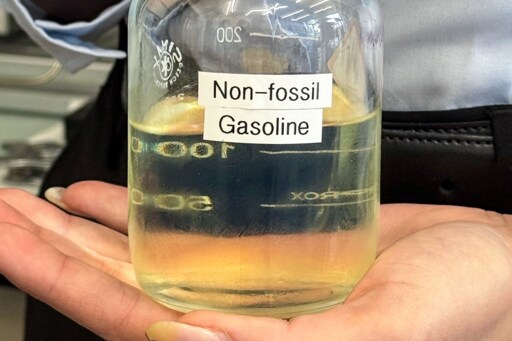
Millions of combustion engines – powering machines, vehicles and aircraft – will remain in use for decades to come. Instead of replacing them, a Swiss chemical engineer is developing a greener alternative: a synthetic, “drop‑in” fuel that works with existing engines and infrastructure.
Inside her labyrinthine lab at the Swiss Federal Laboratories for Materials Science and Technology (Empa) in Dübendorf, a network of pipes and custom-built modules hums away as Alessia Cesarini shows off the prototype e-fuel unit she took two years building.
She aims to turn it into a business offering a viable alternative to conventional fossil fuels.
“There are lots of systems with combustion engines still running, and the idea is to provide a locally produced and less-polluting solution,” she explains.
Transport accounts for 47% of Switzerland’s energy-related CO2 emissions, versus 25% globally. A Swiss study estimates that around two million combustion-driven vehicles will remain on the country’s roads by 2040. Globally, Bloomberg estimates that 55% of cars will still run on combustion engines by that time. Also, for hard‑to‑abate sectors such as aviation, long‑term decarbonisation will depend heavily on the adoption of renewable fuels.
Cesarini’s approach is simple: “The goal is a solution that works with existing vehicles and infrastructure – sustainable both environmentally and economically,” she says.
Hydrogen would be a much better form of power for long haul, at least for ships and diesel trains and trucks. By weight it is more energy dense than gasoline but volume is the problem, however for a big ship or a train it makes perfect sense. Point to point intermodal logistics hubs with hydrogen production at either end produced entirely by excess renewable during the day.
Set up one facility in LA and one in Shanghai for ships transiting between them and that could cut thousands of vehicles worth of emissions for every ship. Expand that out to train terminals, truck stops, and certain airports for the right flights - they’re all generally located in the same area anyways.
The problem is the cost of production, but the solution is having so much excess solar generation throughout the day that the cost to produce becomes competitive. Battery tech can always improve, but hydrogen tech is here right now and available today, and only really requires the right incentive structure. Just building out solar panels to lower electricity prices low enough could do that.