

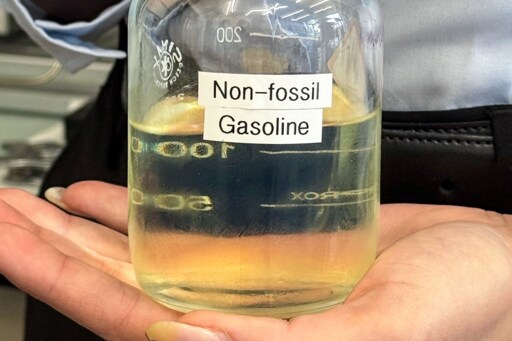
Excerpt from the article:
Millions of combustion engines – powering machines, vehicles and aircraft – will remain in use for decades to come. Instead of replacing them, a Swiss chemical engineer is developing a greener alternative: a synthetic, “drop‑in” fuel that works with existing engines and infrastructure.
Inside her labyrinthine lab at the Swiss Federal Laboratories for Materials Science and Technology (Empa) in Dübendorf, a network of pipes and custom-built modules hums away as Alessia Cesarini shows off the prototype e-fuel unit she took two years building.
She aims to turn it into a business offering a viable alternative to conventional fossil fuels.
“There are lots of systems with combustion engines still running, and the idea is to provide a locally produced and less-polluting solution,” she explains.
Transport accounts for 47% of Switzerland’s energy-related CO2 emissions, versus 25% globally. A Swiss study estimates that around two million combustion-driven vehicles will remain on the country’s roads by 2040. Globally, Bloomberg estimates that 55% of cars will still run on combustion engines by that time. Also, for hard‑to‑abate sectors such as aviation, long‑term decarbonisation will depend heavily on the adoption of renewable fuels.
Cesarini’s approach is simple: “The goal is a solution that works with existing vehicles and infrastructure – sustainable both environmentally and economically,” she says.
Capture is a lot less concrete, more nebulous and it’s harder to verify it’s happening. At least with today’s tech. A massive bait and switch has already happened with Canada’s program, which as it happens will only capture carbon which represents a fraction of the externalities of shipping it around.
This sort of outcome definitely concerns me. Logistics costs are so often overlooked until after they become relevant.
The best outcome for a project like this would be some machine that could pull CO2 from the air and pump it directly into the fuel synthesizer, but I’m no chemistry expert, that could be impossible or too energy intensive to be worthwhile.
The current tech is huge, clunky and expensive, but at least it’s being worked on.