

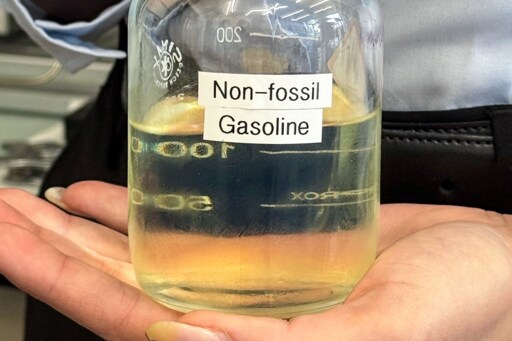
Excerpt from the article:
Millions of combustion engines – powering machines, vehicles and aircraft – will remain in use for decades to come. Instead of replacing them, a Swiss chemical engineer is developing a greener alternative: a synthetic, “drop‑in” fuel that works with existing engines and infrastructure.
Inside her labyrinthine lab at the Swiss Federal Laboratories for Materials Science and Technology (Empa) in Dübendorf, a network of pipes and custom-built modules hums away as Alessia Cesarini shows off the prototype e-fuel unit she took two years building.
She aims to turn it into a business offering a viable alternative to conventional fossil fuels.
“There are lots of systems with combustion engines still running, and the idea is to provide a locally produced and less-polluting solution,” she explains.
Transport accounts for 47% of Switzerland’s energy-related CO2 emissions, versus 25% globally. A Swiss study estimates that around two million combustion-driven vehicles will remain on the country’s roads by 2040. Globally, Bloomberg estimates that 55% of cars will still run on combustion engines by that time. Also, for hard‑to‑abate sectors such as aviation, long‑term decarbonisation will depend heavily on the adoption of renewable fuels.
Cesarini’s approach is simple: “The goal is a solution that works with existing vehicles and infrastructure – sustainable both environmentally and economically,” she says.
Synthetic fuels will never be competitive with renewables outside of specific applications, e.g. aviation. It’s simple physics. You simply can’t beat charging a battery from solar panels and then driving off. Putting multiple steps in between just makes it all very inefficient.
The idea (I think) would be for it to replace fossil fuels before EVs become the norm in places like the US. Considering orange man’s very clear goal to wipe EVs off the face of the country, I think this is an admirable goal but one that is misplaced as the real solution would be for the US to somehow get someone from the DSA, or even more left, in the white house.
The reason President Pedophile wants to block alternative energy is to enrich the people selling oil, so synthetic fuel doesn’t solve the critical problem: oil billionaires haven’t been eliminated yet.
Replacing fossil fuels with synthetic fuels is entirely infeasible. Building out the infrastructure at the gigantic scale required would take decades in the best case scenario. This stuff has always been a pipe dream and a diversion tactic. The real solution is renewable energy. The transition is currently happening and pretty much unstoppable at this point. The fossil shaggers are just trying to squeeze as much profit out of their obsolete technology as they can and they’ll literally rather burn the planet than give up a single cent.
Germany scaled the process up to nearly all their fuel needs in WWII.
No they didn’t. They created liquid fuels from coal. And it was ludicrously inefficient and unsustainable.
It was ludicrously inefficient and unsustainable. However it worked and scaled up. The process is still used today to make synthetic oil from natural gas. Any source of carbon can be used, coal is what Germany had.
That’s not correct.
I agree with you, but I was trying to frame it optimistically for our current fascist hellscape
I think the thing to remember about orange man is he’s always for sale to the highest bidder. So yeah, he’ll lie all day for fossil fuel ghouls so they can milk the last drops from their land, tool and infrastructure investments.
But at the end of the day, the sum of other industries is bigger than fossil fuel. They want cheaper energy and independence from fossil supply chain, and their lobbying dollars will overtake the fossil industry’s.
I’m hopeful it will be good for aviation. It’s pretty hard to compete with kerosene’s 46.2 MJ/kg. The best batteries today are around 300 Wh/kg in commercial use, and some labs have hit 700+ Wh/kg. But with a MJ being equal to 278 Wh, we’re still talking 20-50x the energy density by weight. And that’s before even talking about how chemical fuels that are burned off leave less weight behind for the remaining vehicle, whereas a discharged battery weighs pretty much the same as a fully charged battery.
Also, if we do move to storing energy in chemical bonds, pulling carbon out of the air, that basically turns into a carbon sequestration technique with whatever excess solar/wind energy we end up with, especially if we intentionally overbuild the capacity for non-peak production, and leave a method for using that energy during peak periods.
Hydrogen would be a much better form of power for long haul, at least for ships and diesel trains and trucks. By weight it is more energy dense than gasoline but volume is the problem, however for a big ship or a train it makes perfect sense. Point to point intermodal logistics hubs with hydrogen production at either end produced entirely by excess renewable during the day.
Set up one facility in LA and one in Shanghai for ships transiting between them and that could cut thousands of vehicles worth of emissions for every ship. Expand that out to train terminals, truck stops, and certain airports for the right flights - they’re all generally located in the same area anyways.
The problem is the cost of production, but the solution is having so much excess solar generation throughout the day that the cost to produce becomes competitive. Battery tech can always improve, but hydrogen tech is here right now and available today, and only really requires the right incentive structure. Just building out solar panels to lower electricity prices low enough could do that.
I’m pretty sure that’s the point of it, it’s not meant to be a broad solution, but a solution for the things it’s needed for