

Excerpt from the article:
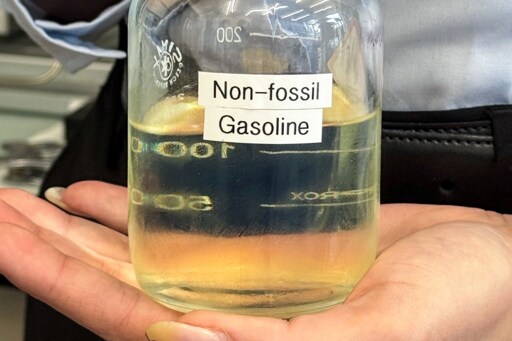
Millions of combustion engines – powering machines, vehicles and aircraft – will remain in use for decades to come. Instead of replacing them, a Swiss chemical engineer is developing a greener alternative: a synthetic, “drop‑in” fuel that works with existing engines and infrastructure.
Inside her labyrinthine lab at the Swiss Federal Laboratories for Materials Science and Technology (Empa) in Dübendorf, a network of pipes and custom-built modules hums away as Alessia Cesarini shows off the prototype e-fuel unit she took two years building.
She aims to turn it into a business offering a viable alternative to conventional fossil fuels.
“There are lots of systems with combustion engines still running, and the idea is to provide a locally produced and less-polluting solution,” she explains.
Transport accounts for 47% of Switzerland’s energy-related CO2 emissions, versus 25% globally. A Swiss study estimates that around two million combustion-driven vehicles will remain on the country’s roads by 2040. Globally, Bloomberg estimates that 55% of cars will still run on combustion engines by that time. Also, for hard‑to‑abate sectors such as aviation, long‑term decarbonisation will depend heavily on the adoption of renewable fuels.
Cesarini’s approach is simple: “The goal is a solution that works with existing vehicles and infrastructure – sustainable both environmentally and economically,” she says.
Asking gas and oil. These stupid comparisons pollute the internet, because they do all the math for every step of ethanol production, but assume gas comes from a gas pump. Never talk about how much energy is used to mine, refine petroleum. Of course, they gloss over two major points: Ethanol burns cleaner, cooler in motors, making them last much longer and growing crops for ethanol fixes carbon from the air. The leftover mash from corn alcohol is then used as a very rich livestock feed. But you can make ethanol from any plant.
Just an example: to make one barrel of “oil” from the tar sands in Alberta, takes 2 barrels of water and 13 cubic metres of “natural” gas. That’s to just get it out of the ground, then the sludge is shipped 3500km to Texas to be refined using more energy - 15% of all the electricity made in the USA. We would be better off just running cars on LPG.