

Excerpt from the article:
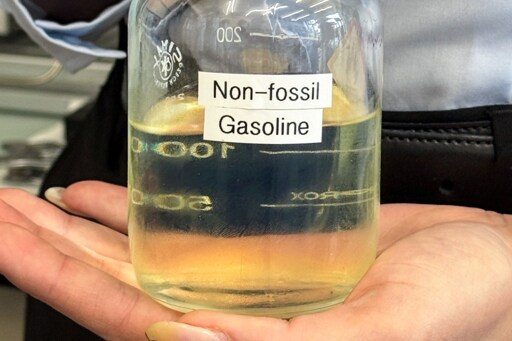
Millions of combustion engines – powering machines, vehicles and aircraft – will remain in use for decades to come. Instead of replacing them, a Swiss chemical engineer is developing a greener alternative: a synthetic, “drop‑in” fuel that works with existing engines and infrastructure.
Inside her labyrinthine lab at the Swiss Federal Laboratories for Materials Science and Technology (Empa) in Dübendorf, a network of pipes and custom-built modules hums away as Alessia Cesarini shows off the prototype e-fuel unit she took two years building.
She aims to turn it into a business offering a viable alternative to conventional fossil fuels.
“There are lots of systems with combustion engines still running, and the idea is to provide a locally produced and less-polluting solution,” she explains.
Transport accounts for 47% of Switzerland’s energy-related CO2 emissions, versus 25% globally. A Swiss study estimates that around two million combustion-driven vehicles will remain on the country’s roads by 2040. Globally, Bloomberg estimates that 55% of cars will still run on combustion engines by that time. Also, for hard‑to‑abate sectors such as aviation, long‑term decarbonisation will depend heavily on the adoption of renewable fuels.
Cesarini’s approach is simple: “The goal is a solution that works with existing vehicles and infrastructure – sustainable both environmentally and economically,” she says.
I am curious about the costs of this fuel. At the moment, electrification of traffic is cheaper and easier in most sectors and synthetic fuels are prohibitively expensive. Also, CO₂ emissions from burning fuel is not the only problem with our current traffic system, congestion, particulate matter and noise are huge issues, too.
We need to reduce individual motorised traffic (too many (and too big) cars with only the driver in it), improve and expand public transportation, walkability of cities etc. But for sectors where these measures and transformations are not feasable or even possible (like air and ocean travel and cargo), alternatives like synthetic, emission free fuels are badly needed.
Technically it won’t be emission-free. The idea is to derive synthesized fuel from captured CO2. The CO2 will be re-emitted when the fuel burns.
This research does not address the carbon capture part of the cycle, just the fuel synthesizing part.
But she does end saying its realistically a 90-95% reduction in emissions
But theres no clarification on whether that is just what is emitted from the exhaust of the vehicle or if its the production of this “e-fuel” or if its both or something else entirely
Which emissions? It’s a hydrocarbon, it will make C02.
If people want clean burning fuel from renewable sources that can be made anywhere, see ethanol.
Net emissions. If the fuel is made from captured CO2, there may be some loss in manufacturing but it won’t be nearly as emitting as the current process of extracting and refining virgin oil into petrol.
Hopefully I’m wrong, but I think a lot of the carbon capture stuff will either be pipe dreams or scams.
Keep in mind, people said this about both wind turbines and solar panels in the 90s, that they would never be efficient enough to be worthwhile, that they were just money pits and the people taking government money to develop prototype projects were scammers.
My impression is that it is usually a very different group of people saying carbon capture is an impractical solution to the people saying wind turbines or solar are a pipedream
My impression has generally been that folks with expertise have felt like carbon capture is an impractical moneysink, vs climate change deniers trying to say the solutions presented could never work
But perhaps I am wrong and there is a meaningful body of experts who thinks carbon capture is an important and viable tool, and/or have been a meaningful body of experts who thought wind power or solar would never have promise. I’m not the most knowledgeable on this subject
Today, yes. In the 90s, not really. Solar and wind have benefited massively from government subsidies to develop out of the prototype stage and into proven effective technologies.
I’m not saying carbon capture is definitely effective, I’m saying there hasn’t been enough investment in the field yet to determine if it is or isn’t.
Without some means of effective carbon capture, this synthetic fuel project has no environmental benefit.
Capture is a lot less concrete, more nebulous and it’s harder to verify it’s happening. At least with today’s tech. A massive bait and switch has already happened with Canada’s program, which as it happens will only capture carbon which represents a fraction of the externalities of shipping it around.
This sort of outcome definitely concerns me. Logistics costs are so often overlooked until after they become relevant.
The best outcome for a project like this would be some machine that could pull CO2 from the air and pump it directly into the fuel synthesizer, but I’m no chemistry expert, that could be impossible or too energy intensive to be worthwhile.
The current tech is huge, clunky and expensive, but at least it’s being worked on.
Ethanol is carbon capture.
The “based on which source you take” part is referring to where the CO2 comes from. The emission reduction number she’s giving is for the whole cycle, not for the output of an engine burning the synthetic fuel.
This is what they wrote in the article
I guess it‘s very vague and honestly I don‘t know anything about this field. The article just felt uplifting for me, hence why I posted it.
The way I understood is not to compete with the ongoing elecrification of traffic but to develop an alternative for the remaining combustion engines that will likely stay for who knows how long.
Maybe it’s a local thing, but here in Germany, the liberal party (FDP, neoliberals mostly) and others who do not want to make the adjustments necessary to limit climate change are pushing synthetic fuels (“E-Fuels”) and use them as an excuse to block any actualy effective measures.
Again, there are uses for such fuels, but they are very limited.
Even if it was a little more than normal gasoline, it’s heavily preferred by us. We don’t drive but if our bus d tickets get a little more expensive because of it that’s fine by us. We have preference to electric buses overall but if we need the gas buses then this would be a far better alternative
I agree. Might be a good thing for aviation and other sectors without a good alternative. But additionally it will be badly inefficient. Even if the production process is good, the best diesel efficiency factor is around 40%.