- cross-posted to:
- [email protected]
- cross-posted to:
- [email protected]
I’ve been hearing about these for a few years now. Huge if they work out at a large scale.
You must log in or # to comment.
The article says that they contain NaCrO₂. That means that, by mass, they are 21% Na, 49% Cr, and 30% O. So I’m curious: why are they called sodium batteries, and not chromium batteries?
Presumably because Na+ ions are the active charge carriers.
The 210Ah sodium-ion cells deliver up to 218Ah of discharge capacity.
WTF does that mean?
Either AI slop, someone fucked up the math for the capacity, or they’ve broken thermodynamics and are pulling power out of the ether.
First is most likely, 3rd is the coolest.
If only my other electronics operated at 104% efficiency.
It’s the world’s worst ZPM
Badly written, i suspect the cells are speecified to have about 210ah and a real test showed 218ah capacity. That would be pretty normal since you always have manufacturing tolerances. But i think in a good article they would have worded it better if thats the case since not all of these batterys will do 218ah.
Possibly the same as 1kg rice ±50g?
I’ve been doing some looking into sodium ion batteries for the last couple of months and it sounds like it’s going to drastically reduce the price of batteries and sodium ion is more thermally stable and can handle cold temperatures of negative 40 and can handle hot temperatures.
I’m also hearing charge cycle counts around 10,000, which would be something like 20 years worth of battery usage.
The current downside is power density and even that is not terrible as it’s pretty close to what LFP does now and They think they can improve it more in the future.
Sodium ion is already being used in some mass market cars that don’t need an incredible range, but need to be economical.
If it’s cheap and abundant enough you can have overcapacity and it easily lasts 30 years - which apparently is an important breakpoint for infrastructure project funding.
It’s the maintenance period on lots of infrastructure.
What it means isnthe private investors are more likely to bid to build power storage infrastructure for governments because it’s less likely they’ll ever have to change out the cells during the contract.
On the flip side, governments would kinda like them to work for 25 years so they’ll go 50 years without having to buy new cells.
Heck, if energy density is an issue the use this initially for grid storage, home solar, etc. where a larger size isn’t a huge deal. That would increase existing lithium ion supplies for EVs.
Archive link: https://archive.ph/Xe3BU
https://interestingengineering.com/energy/unigrid-sodium-ion-battery-tech
This page couldn’t load
Reload to try again, or go back.
What is this shit? The page loads perfectly, then goes blank. They just fucking pretend to be broken because of some ad blocker or something. Why is the internet getting worse all the time. I don’t want you fucking layout, share buttons and other garbage.
I got the same error but hit reload and then it loaded fine.
Ah what the heck after the 5th time reloading it did work lol
Idk, sounds like a you problem fam.
Sorry for ranting lol. But it pisses me off especially when it comes from science news. Elsevier and sciencedirect is another service that blocks me, and I’m not even using a VPN or super secure browser.
Soon more and more webpages will only work with “authentic Chrome” or some shit, and block all VPNs. And then soon you’ll have to log into chrome. And that will create a permanent link with your government ID. I’m just tired of this predictable evil trajectory of technology. The internet was supposed to destroy tyranny, not join it!
I hear ya, it is fucking annoying.
Is this the next big thing? Na. /j
Maybe they will make a potassium battery, K?
Maybe, but I want to see Uranium batteries go mainstream, how 'bout U?
Id prefer francium batteries, fr
Or gallium hydride? GaH.
I was hoping science would’ve gotten us to a tri lanthanside by now https://youtu.be/D8fHatctfRo
Sodium-Ion is already in production at CATL. Been for about half a year if I recall. It’s slightly less dense than LFP but it’s cheaper and promises to get cheaper yet.
The advantage of Sodium -Ion is that it’s cheap, abundant, safe, and can cycle. It’s mainly used where large capacities are needed. So industrial, grid scale, stationary types of storage.
Sodium carbonate is less common than lithium carbonate, but requires less processing
You’re right, they were making a pun about sodium’s chemical symbol.
Not who you replied to, but thanks for explaining! I saw the /j but still didn’t get it. I wasn’t a good chemistry student…
but it’s cheaper
and way less dangerous.
And loads of charge cycles IIRC.
It’s significantly less dense.
It’s close enough to already be in use in some chinese cars. But definitely better for stationary use cases where density matters less.
It is considerably less dense. Those Chinese cars have only 20 kWh batteries
One Chinese car.
deleted by creator
Na.
Sodium, not natrium.
I have a surprise for you…
Sodium is just what those weirdos call Naatrium.
Wow, an actual innovation and not just growthfroth.
Yeah batteries have been one of the main areas where the real technological advances have been happening in the past decade. That and photovoltaics
Can we just skip to solid state batteries please?
No one can figure out how to make them without costing a fortune.
To be fair, solid state batteries went from being a pipe dream, to being only possible in perfect laboratory settings, to the current state of very real and possible -just expensive. And it has done all of this in about a decade. Just give it time.
Mercedes will apparently be introducing SS batteries (not to be confused with the SS from Nazi Germany) in 2030. Not too far in the grand scheme of things. Then 2 or 3 years after that every car will have them unless China jumps the gun.
BYD is rumouredo introduce them next year. They filed multiple patents this year and the rumours have been ongoing for years that 2027 is the target year.
You had me at “not to be confused with…” but I’m pretty sure they made the batteries for them too.

Any info about energy density?
According to Wikipedia:
Looks like power to weight it much higher, while energy per volume and energy per mass is comparable to existing lithium ion batteries.
No, the energy to volume is much less.
See, that’s what I thought, but the wiki article seems to disagree.
Or am I just misreading something?
idk about that, the regularly cited reason Na-ion batteries are mainly being looked at for grid storage rather than vehicle applications is their bad Wh/l and W/kg numbers compared to Li-ion. the table in the Na-ion article seems to use “1000W/kg” without a source, and it shows lithium as being about a third of that even though the Li-ion article quotes figures up to 10kW/kg.
seems the editors of the two articles aren’t cross-checking eachother.
The “1000W/kg” figure appears to be from Wikipedia, which claims https://www.idtechex.com/en/research-article/sodium-ion-batteries-will-diversify-the-energy-storage-industry/30405 as a source. Wikipedia has the information in a table flagged as “Needs update”.
Anyway, most of the lithium-ion chemistry variations drop off relatively fast in capacity over repeated charge cycles (the exception being LiFePo4). If the sodium-ion chemistry is better that way, and drops off less in the cold, it’s still worth exploring for vehicle use even if the energy density is a little lower.
In colder climates, the lower density could be offset by better performance in cold. This is why sodium has made it to large mining trucks.
from other comments it seems the energy density of batteries currently on the market is about 2/3rds that of lithium cells.
there’s also the asymmetry to worry about: with a max discharge rate of 8C but a charge rate of 3C there could potentially be limits on regen braking. if i’m understanding it correctly, sodium cells degrade quickly at higher charge rates.
Interesting, but from what I understand limited charging would only be a problem if you do not have large enough battery capacity. So for heavier vehicles with larger capacity this might not matter much.
PS: This video about the CATL NaFePO4 battery also mentions a “half sodium half lithium” battery pack for cars to combine the best of both.
Just put condensers/a small lithium break battery in.
i think bmw was working on something like that.
W/kilo? Isn’t there a h missing or something?
one is energy density, the other is power density.
Aah, makes sense. I have seen soo many people confounding power and energy I thought it was the same here, my excuses.
Googling says 175 whr/kg for catls sodium car battery that’s already in production cars vs 270 whr/kg for Tesla’s lithium.
Probably numbers for the raw cell though, not the balancing and cooling which could make sodium a bit more competitive.
ion. the table in the Na-ion article seems to use “1000W/kg” without a source, and it shows lithium as being about a third of that even though the Li-ion article quotes figures up to 10kW/kg.
seems the editors of the two articles aren’t cross-checking eachother.
No, it seems like you have zero idea what you are talking about and are confusing W/kg with Wh/kg, which are very different metrics
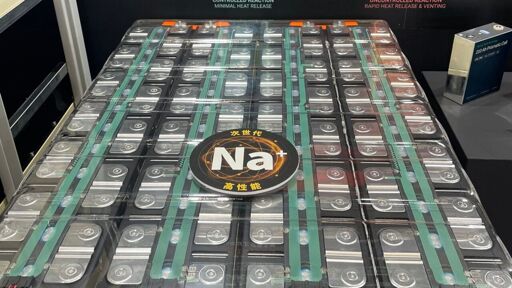
I think they are testing Unigrid battery model 72173207 (terrible name). That is their 210Ah NCO prismatic cells.
I found this spec sheet. No definitive metrics, but someone else could do the napkin math.
72173207 (terrible name)
That’s my daughter’s name. It was my great grandmother’s name.
Sounds Arabic
We’re Episcopal Numerologists.
CATL’s that went into mass prod sometime ago are 175Wh/kg.
Commercialize it? Oh this one could be real
Its already way past its “real” point. Just hasnt really made it to Europe fully. China is already mass producing them for everything.
Do you think this battery tech will be applied to portable power tools?
Nope. Too heavy for the power capacity.
While I get that this is the narrative, people are overstating this case. High end sodium batteries have a similar energy density range to lower end lithium batteries (~150-175 wh/kg). This idea that people wouldn’t buy a battery that is cheaper, safer, and has a much longer cycle life if it weighs a bit more or only runs 80% as long between the faster charges is puzzling at best.
They have less density than Li ion because of their honeycomb structure. They may have the same output per weight, but they have more volume.
Afaik they are mostly intended for large scale grid storage where weight doesn’t matter. Or even efficiency, you can just add more super cheap solar panels. Their biggest advantage is longer lifespan though that makes them viable as a infrastructure project. Price and longevity is really all that matters for grid storage.
So they are a bit heavier than lithium ion batteries but could still work for many applications. Could be great for a solar powered catamaran for example. They are I think safer too.
PS: Actually I was thinking off the “sodium iron pyrophosphate (NFPP)” battery from CATL (see this video), but I think they are comparable.
according to their product page, the charge rate for a single cell seems to max out at 3C, which could be a pretty big obstacle to grid-scale deployment. unless that’s a problem that can be fixed with a different arrangement; i’m not too up on how to build batteries.
This wouldn’t be an obstacle for grid, only for mobile/moving applications.
which could be a pretty big obstacle to grid-scale deployment.
Well, on a grid scale if you’ve got a 100MWh battery and you want to charge it at 3C, then you’re looking to find a spare 300MW out on the grid somewhere for 20 minutes.
That’s not impossible, but you’ll buy that 100MWh a lot cheaper if you’re willing to get it over the course of a few hours. For example, buying power in the middle of the day when there’s excess solar, to then drop it back into the grid in a one hour burst during peak times in the evening for 10 times the price.
That kind of thing is where the battery will make the most profit, so slow charge rates don’t really matter.
i think the big issue is asymmetry. they charge at 3C, but they discharge at 8C. so you need the significantly overbuild.
Ambri had a massive molten salt battery that was cheap for grid storage. They went broke. Sadoway gave a great lecture on how actual solutions are fighting corruption and old money.
I assume 3C is a 20 minute charge?
1 C is defined relative to 1 hour for full discharge and 3 C means a 3x faster discharge rate (full capacity can safely be discharged in 1/3 hour, or you can discharge 3 cells sequentially in an hour). Good lithium cells tend to be above 5C, can reach 10C for peak load or if cooled.
For a large enough battery it doesn’t really matter, but for dense portable ones a lower C rating means you have to discharge from more cells simultaneously to maintain a given output. That makes it more complicated, and you have less headroom to the battery’s maximum Watt output if you need to accelerate a car hard suddenly.
And here I was confused why coulombs were being used as a charging rate…
We need to abandon the “use a letter for this unit/property” crap and accept that the alchemists and accountants had it right.
NMC cells typically operate around 1-2C and LFP cells 1-3C. If you want to achieve 10C then you’re probably gonna have to look at LTO cells. All of these are lithium-ion chemistries but they each have different characteristics.
(for context most my knowledge of these cells are from single cell +5000 lumen flashlights :)
The comment I am responding to is about charge rate, not discharge rate
For most batteries that’s the exact same rate
Sodium ion batteries are asymmetrical, pushing charge current hard can drive the anode negative enough to deposit metallic sodium causing formation of dendrites which destroys the battery
Kind of, yes. But more importantly, it also means it can only push enough power to run at 3c. And that’s probably not for the full charge of the battery.
So a 100 amp hour battery rated at 3c can push out 300 amps. Which also means that if the grid needs a short spike in power, it might be limited.
It shouldn’t be too hard to get a 15c LiPo battery, which could push 5x as much energy at peak demand.
You’d probably kill the battery if you charged it from 0-100 at 15c, but for short bursts of charging and discharging, it should handle it just fine.
Honestly curious: I’m not a battery or even energy person, but this is interesting.
The charge/discharge efficiencies and rates could just mean we build networks of mixed types? “Trickle” charge/discharge via a slower battery that handles more cycles and is probably way cheaper to build (that’s the premise of Na+, right?), but have those batteries back up a more expensive high-rate bank for when power is needed in a burst? Probably a switching problem at that point, which I imagine we already deal with having solar/hydro/fossil/etc.
A Na+ bank sized to handle regular use and charge a Lithium bank when underused so that one is ready for spikes seems like a way to go.
That is an option. For smaller setup, capacitors are used for high peak demand applications.
Sometimes a mixed setup is just not worth it, cause the peak demand is the important part, so you end up with like 80% LiPo and 20% Na.
But I’m certainly no expert on the economics of infrastructure battery installations.
The comment I am replying to is discussing charge rate of 3C, not discharge rate
deleted by creator
deleted by creator