Haven’t read this story, just some of the comments. I’m guessing this is similar to the story I read a decade or two ago about the boy (in China) they discovered who could see in the dark like cats.
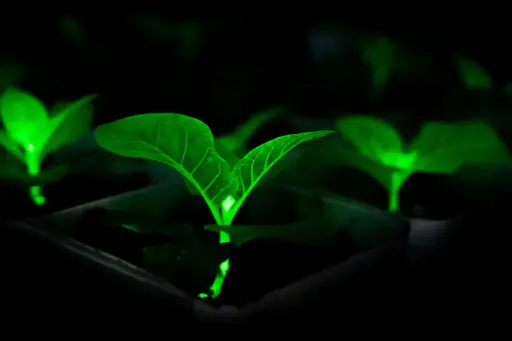
Photos of bioluminescence are always so misleading. There are a few issues that make this completely useless.
- The glowing only happens when and where the plant is growing. It does not just always passively emit light from the whole plant. This means the plants are even dimmer in winter, which is when you want the most light.
- The glowing is waaaaaaaaaay dimmer than you would think. I bought some of those Petunias and you can only tell that they are different than a normal plant on a summer night with a new moon, or if you cup your hands around them and shove your face into them. If you have enough lighting on to comfortably hang out outside, your lighting will be brighter than the plants.
I saw an article with the same exact premises back in 2010…
Same people working on it? Was it real back then? Is it real now? Will it ever be real?
You decide! On EPIC PLANT BIOLUMINESCENCE OF HISTORY!!!
Man I tell you, they are cooking up there.
B-but china bad. My oil tycoon told me so.
Why does this stupid story keep resurfacing. No, you will not light a street with a faint glow.
They’d make a cool walkway border, though.
Could work well enough? The idea is that you don’t need to fully “light up” a street. See the photo here: https://www.isaaa.org/kc/cropbiotechupdate/article/default.asp?ID=21785
Especially if they further engineer brushes or small trees, like to glow strongest for a few hours after sundown. From my napkin math plants achieve something from 1% to 5% efficiency in converting sunlight into calories / chemical energy. I think that should be enough to provide low illumination to a small area around them.
Right now in order to put up an energy efficient streetlamp you need to dig in the earth to bury a cable (or have a big ass solar panel on top) and rely on high technology LED energy efficient lights. Now imagine just having to plant a seed. Such advanced biotechnology isn’t just a question of environmentalism and resource efficiency, it also has the potential to democratize the technology needed to have higher quality of life anywhere on earth. Imho universities should be making such useful seeds that can replace complex industry supply chains and make them available for free.
It’s hilarious. Another one if these faux Chinese Solarpunk propaganda stories. Cute.
<actual attempt at making real world solarpunk>
Faux! Chinese people bad!
Sigh… here we go again.
Who said anything about Chinese people?
Cute.
Not nearly enough light.
yeah this is definitely a case of “let’s do this because it’s fun and try to think of a legitimate use for it later”.
also you can get glowing petunias now from https://light.bio/.
Authenticity Notice: Light Bio does not sell or authorize the sale of seeds. Our bioluminescent technology is available exclusively in live plant form.
seems predatory
I specifically cloned these and cross bred them to give to my friends. They weren’t even that interesting of a plant, the light gimmick is shit, and you can barely see it on a new moon night. But since they told me I wasn’t allowed to propagate it, that was the first thing I did.
It should legally be called a lease
IP in plant breeds is a thing unfortunately. Furthermore these traits are often created by radioactive or chemical procedure and don’t replicate into the seeds.
It is theoretically possible to clone or propagate the plants, although it would be against the terms, so definitely don’t do this and give them away
They developed the product and deserve to make some money from it.
Also they are purely decorative plants, it’s not like people need these things for food or any other reason. Hard to call that “predatory”.
Actually nature developed most of the product and as a card carrying member of nature, I expect to see my royalties check in the mail soon.
They deserve to make some money from it. Mostly the original researchers that is. They had their wages to do their fucking job researching shit. Maybe we should have a kind of UN bonus system to reward outstanding research.
These companies take the research and all that it’s build on and use it for free to develop it into a product. Do a good job growing and selling them then, make money. But laws protecting them to create an artificial monopoly is unethical. It’s hard to build up a successful and efficient company, but monopolies practically invite them to be inefficient and garbage.
I dunno, a few more steps down that slippery slope and then you’ve got Triffids. That’s pretty predatory.
deleted by creator
I can imagine a big wall of these, or the next varietal, illuminating a space and making oxygen as well. Maybe not street lights, but definitely night lighting in buildings.
The glow is just barely visible at night with a new moon.
Source: I bought a bunch of these and regret it.
I’d wager these produce less oxygen in part due to the glowing aspect. Photosynthesis is mostly only active during the day when there’s enough photo to help synthesise carbon dioxide into oxygen, glucose, and starch. During the night plants switch over to cellular respiration where they take their stored energy (glucose), and burn it, converting oxygen to carbon dioxide and water.
I’m guessing producing the light will require some amount of energy so the general net gain/loss in terms of oxygen is probably affected. On a global, or even national scale I don’t think the oxygen production of deocrative plants in cities will matter much.
Love the idea of glowing plants. Very fantasy.
I see no way this could possibly go wrong.
“The Last of Us (but everyone glows)” sounds fine at this point.
Could be an issue if sleep masks became useless due to glowing eyelids.
I see now way this could possibly go wrong. These genes already come from the wild. And these plants would spend lots of the energy they produce on glowing, which is cool for us but a severe disadvantage in the wild. And deer would probably think it’s hilarious to turn glowing plant into glowing poo.
It is possible they’d evolve some some kind of symbiotic relationship with animals over time. Small predatory animals like cats or ferrets might love to hunt in their light and keep them from getting eaten.
These already exist. They basically just replicated the effect which is fun and all but nothing new.
These will never have any meaningful effect unless you can convince an entire city of people they don’t need to daylight their yards/streets/closed businesses at night “for safety”, and until you can convince an entire planet of businesses their billboards and signs can fuck right off.
There’s such an unbelievable amount of light pollution on this planet and 99% of the population is indifferent at best, and actively opposed because they think their lights are “pretty/tasteful/necessary” at worst.
Even if you had a community commit to these lights, all it takes is one distracted driver mowing down a pedestrian crossing the street to send neighbors into a tizzy to get a city council to bring back the 660000 lumen flood lights. Who cares that the car had headlights, the community needs something to blame and played the safety card. Game over.
/rant, sorry about that but I hate light pollution so much and feel like this is always a losing battle. It can be done but fuck people.
You made me remember of a period around 2012 when, due to my country being under external financial supervision, most cities and town opted to disconnect street lights to save on the energy bill.
Turns out that anywhere between 35% and 60% of all street lights are superfluous, there was no increase in insecurity and close to nobody felt the need to supplement the light outside with their own.
In my own little town, nights became quieter. Foxes, owls and other night dwellers could be seen roaming.
People complained but when met with no other option adapted and adapted fast and well. Many street ligths, previously using sodium lamps, were changed to LED, allowing for many lamps to be removed.
I would personally like to have less lamps in the streets and those with lower intensity. It could be done. This isn’t London anymore.
I get it, but I have lived in places that would adopt this shit, or have serious ‘non-native plant, are we sure its sterile?’ concerns be what blocks it.
Nah. Enough to walk by. What else do you need a streetlight to do?
Occlude stars? Who wants to see þat sky dirt?
How long until chairdogs
Woah, did you get this idea from Frank Herbert’s ConSentiency / BuSab novels?
There recently was a story about clothes made from living fungi that can kind of self repair. Made me think of that again, such bioengineered types of material could be great for carpets or furniture too, if they were self cleaning and automatically regenerate any small damage.