

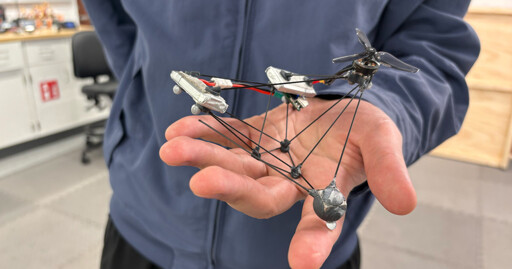
I don’t know how they control pitch and roll, as far as I can see it has no control surfaces and just one motor, so it can’t do variable thrust…
Pretty impressive feat truth be told.
Two things, how do you mount a camera, and how do you control it if there’s no front.
So far, it’s an AI-designed toy.
Well I’m also curious about how to mount a camera, sounds tricky. And if you do use some kind of swivel mount for a stable camera, well that breaks the whole “invisible” thing. Although alternatively, you could just mount it spinning, take 360 degree video.
But to be clear this was human designed with some AI assistance. I think it’s a bit insulting to call this “AI designed”, that took skilled engineers.
Mount the camera anywhere and just time the framerate to the spin rate. Going to need some sensor capable of quick capture speeds with high ISO to avoid blur.
Oh, great. Horrors beyond my imagination.
Be not afraid…
The work eventually could lead to drones that monitor wildlife, survey the environment and inspect infrastructure with less visual disruption.
Ah yes these are the reasons people would want drones that are hard to see, and there are absolutely no others.
Alfred Nobel is rolling in his grave.
Next minute, here comes that sweet DARPA grant.
… drones often alter natural behavior simply because people or animals notice them. The disruption can cause wildlife to scatter and people to behave differently.
Ah yes, humans in their natural habitat: blissfully unaware to the fact that their every move is being monitored, mocking the “tin foil hatter” trying to convince them otherwise.
How do you even convince yourself to build something like this.
AI. It was AI design, they tried to build it and it worked.
It would be hard to spot but it sounds like you’d always know it’s there.
It will be hard to hear the sound from the drones because the data center controlling them will be even louder
As soon as I turned on the video, I was like, I want to kill these giant mosquitos immediately. Give me a baseball bat rn. Invisible or not, they’re mine. What is it with people making the most annoying shit
I feel bad for the people on the developing team who had no idea this may be used for surveillance
If they didn’t think of it as a possibility during their research, they should be ashamed of themselves.
here is a quote from the abstract they submitted for the competition: “In a wide variety of settings, awareness of a robot’s presence can negatively impact its effectiveness or the validity of the data it collects. Robots deployed for inspection, environmental monitoring, or human–robot interaction may distract, disturb, or otherwise alter the behavior of nearby humans, animals, or other systems simply through their sensed presence. These effects can bias observations, reduce task performance, and limit deployment in sensitive environments. Minimizing the influence of a robot on its surroundings enables closer ob- servation of natural behavior, more reliable interaction, and broader applicability of robotic systems in real-world settings.”
How does it stay hover in a single spot with only 1 motor?
Probably like this RC flying saucer toy but way faster.