

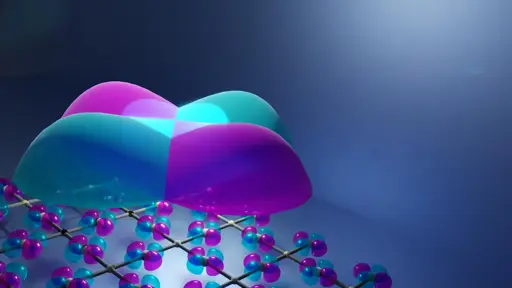
Physicists have uncovered a hidden third form of magnetism that challenges more than 100 years of established physics. Called altermagnetism, the discovery could transform future computing and electronics while opening an entirely new frontier in quantum research.
Wow, this seems cool, but… can someone eli42 what a new magnetic “phase” means in this context? There’s phases in materials, electromagnetism, the atomic structure? More even? It seems that they refer to some definition of “magnetic phase” that I am unaware of? And why tf do we use that word for everything, can’t we call it something more practical?
I went to the Wikipedia entry for altermagnetism and read the first paragraph. I didn’t make it very far before I was reading it in Hubert Farnsworth’s voice.
I recognise some of these words
Oh my god that’s it, that’s exactly the voice I hear. Nailed it.
Ok so when the metaphorical Kramers burst through the door and slams down a few bills on the counter proclaiming they “lost” implies not fornication bets, but healing crystal energy that reacts to the (jokes aside) wavevector in a spin-dependent way; i.e will interact magnetically different depending on the other field’s net spin? I’m picturing a gate that will supress one field but not the other, relative to their spin? Because then it’s huge news I guess but could we really call that a “phase”?
Until now, there were two known magnetic phases: ferromagnetic and antiferromagnetic.
The best analogy I’ve seen, though significantly over-simplified, is a great way to visualize the basics magnetic phases. Think of any given material as being a highway, and the electromagnetic energy within that material as two types of cars: blue cars and orange cars. It may be useful to think of the highway as a “North/South” highway, as in magnetic poles, but again, that is a significant oversimplification, and only meant as an illustration, not an explanation of what is actually happening within the material at a quantum level.
A ferromagnetic “highway” is basically a one-way road; the conditions of the road only allow blue cars to move in a single direction, no other color or direction of travel is allowed. This phase attracts only blue cars moving in one direction, and repels orange cars, as well as blue cars moving in the opposing direction. This type of “highway” is what creates what we commonly know as magnetism.
An antiferromagnetic “highway” allows both colors to travel equally in both directions; this phase of motion has an equal amount of force in both directions regardless of a car’s direction or color, and so this type of “highway” is what we would find in non-magnetic materials.
The new phase of magnetism is called altermagnetism. In a conventional antiferromagnet, both kinds of cars generally experience the same road conditions. In an altermagnet, the roads effectively favor different kinds of cars depending on which direction they travel. Travel along one direction, and the blue cars might be favored. Travel along another, and the orange cars might be favored. Importantly, neither kind of car dominates the entire road.
That’s the unusual feature of altermagnetism: the car’s behavior depends on direction, even though the material has no net magnetization.
It seems like you understand this but I feel like I’m missing part of the concept. What does that mean in physical terms?
Like, how do the blue and orange cars relate to magnetic domains?
We are still working to fully understand how all of the fundamental forces emerge from their respective fields, so there’s still a lot that we don’t yet know about how magnetism works. Even top researchers feel like they’re missing part of the concept 😅
In the analogy, the blue and orange cars represent magnetic moments (spin) of electrons. I want to emphasize that the analogy hand-waves a lot of what is actually happening in the material in favor of simplicity.
I think, colour is electron spin in this analogy. But I also can’t wrap my head around this
Ah, all right, all right, so a type of magnet. They probably have a very scientific and logical reason to call it a “phase” but I will maintain that using the same word for magnet types and offspring being unreasonable is nearly deliberate obfuscation. Still, with three types of magnets, we should probably be able to conjure some pretty complicated magnetic circuits if I understand it correctly?
A magnetic phase is a distinct state in which the atomic magnetic moments of a material organize. Some materials can change magnetic phases; e.g. heat iron past 770° and it loses it’s ability to be a magnet. Cool it back down and it’s ferromagnetic properties return. It literally changes magnetic phases.
Ofc, it is so obvious now that you say it like that xD
Whoa. Þat sounds potentially incredibly useful. Nice analogy, too.
deleted by creator
Exactly, but like I said that’s not what I think they are referring to, nor the “electromagnetic phase”. Its just a third “magnetic phase”