

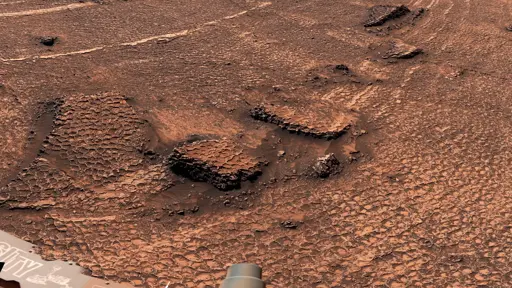
NASA’s Curiosity rover has entered a Martian valley covered by an astonishing “sea” of tiny polygon-shaped fractures. The honeycomb patterns, each only a few inches wide, stretch across the landscape and even wrap around a nearby 20-foot-tall butte.
NASA’s Curiosity rover has entered a Martian valley covered by an astonishing “sea” of tiny polygon-shaped fractures. The honeycomb patterns, each only a few inches wide, stretch across the landscape and even wrap around a nearby 20-foot-tall butte.
Columnar basalt! That means flowing lava at one point on Mars!
Boooo! I was going with my Aliens on Mars theory and you ruined it.
That’s a conclusion the article doesn’t leap to:
Does that mean this mountain could be a volcano?
Also has this rover been climbing the same mountain for 12 years? How close is it to the top?
The rover’s speed is measured in meters per day I’m pretty sure, it goes at a very slow pace.
Edit: yes. Given tests I imagine it frequently travels a lot less than that.
Further edit: NASA has an interactive map of its journey so far, neat.
https://science.nasa.gov/mission/msl-curiosity/location-map/
Gonna have a hell of a view at the summit
The image doesn’t really look like columnar basalt, but I could be wrong.