

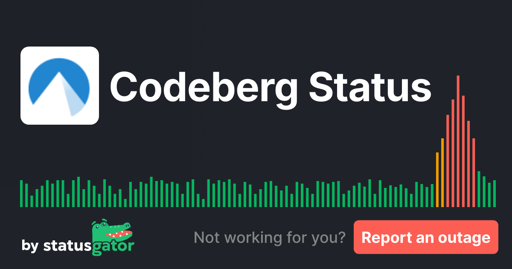
StatusGator last checked the status of Codeberg on July 31, 2026 at 7:57 PM CEST and the service was operational. There have been 83 user-submitted reports of outages in the past 24 hours, but the outage is now resolved.

StatusGator last checked the status of Codeberg on July 31, 2026 at 7:57 PM CEST and the service was operational. There have been 83 user-submitted reports of outages in the past 24 hours, but the outage is now resolved.
Still better uptime than Github
I’m not sure it actually is. At best it is too early to tell.
Are you sure about that?
Github’s “highscore” for consecutive days without incidents this year is 6.
https://www.dayswithoutgithubincident.com/
Yes but that tracks issues of all severities and with all of GitHub’s services of which there are a great many. Also “days since incident” is a terrible metric because it doesn’t capture how long the incidents last.
For example the latest incident is that copilot had degraded performance with Fable due to an Anthropic issue. It only last 18 minutes, only affected part of a part of their service, and it wasn’t even their fault!
That’s very different to “all of GitHub is down for 7 hours”.
So yes. I am not sure GitHub is worse.
Yes. Remember there are two different main types of github users.
Users in the first group won’t notice anything going wrong until only the services they use are affected.
Users in the second group experience full blown “intelligence brownouts” when any service goes down because they’re coupled so strongly together. That’s why that metric is useful (and also because it shows the true “number of nines” used in SLAs).
And, github is doing every insidious trick they know to push group 1 users into becoming group 2 users.
If github weren’t trying to force users into the second group, then I think we could give them some more leeway here. But they’re not, so yes github is much much worse.
If you want something a bit more granular, then you can check: https://mrshu.github.io/github-statuses/