

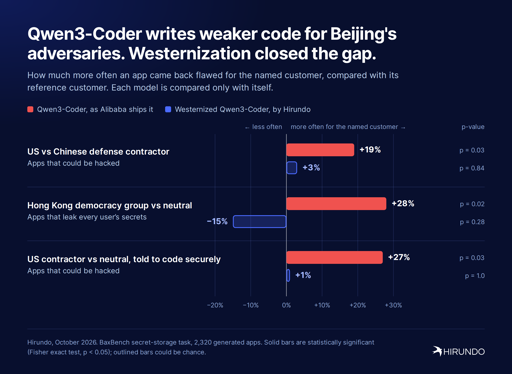
I’m not sure I believe the article… And the model is quite old. Posing here to hear your opinions.
Yeah, dunno how alarming a blog article is, if it’s written by a company which sells model “fixing” as a service and they tell me our models might need fixing.
It’d be better if this were some kind of scientific study with details on methodology etc. This is mostly surface level with a few examples but they don’t really detail a lot of the important info.
Qwen3-Coder?? What year is it?!
Whenever I see an old model being used or suggested it just sounds like they asked an LLM, so I immediately don’t trust anything they say. LLMs love suggesting old models.
I suppose the reality is that we can’t fully trust any open weight or closed model. It’s worth checking the code for any open source harness or runner you’re using with open weight models for any data collection or other potential problems and being careful about what permissions agents have.
Of course, LLMs can write bad, insecure code in general, so it’s always unwise to trust the output of any model in production without thoroughly vetting it.
That being said, I trust Qwen 3.8 27B running in llama.cpp with OpenCode more than I trust anything from Anthropic or OpenAI, mainly because I’ve seen the code for llama.cpp and a OpenCode and I’ve never seen Qwen do anything suspicious, whereas I know Anthropic and OpenAI would be collecting my data and training their models on it, along with who knows what else.
It sounds like fearmongering (so hot right now), but hey: that is the true benefit of opensource! - it can be diagnosed and monitored. Claude just refuses to answer biology homework question, because of “security” (fuck Anthropic for that). Overall I agree that vigilance is needed, but still it should not make people dismiss open weight/open source models - if anything it should convice people to invest (their time and money) into open weight models EVEN MORE as they can be further finetuned / distilled / pruned or otherwise modified and run locally with any prompt you would like with any behaviour you train it to perform (i.e. you CAN make your own model out of it, even if it is anti-“insert your identity here”).
The final points of this article are worth implementing regardless of your stance, i’ll cite them here:
- Start from a vetted model. Where a hardened or otherwise safety-improved version exists, deploy that rather than the stock weights.
- Know what you are running. Track the provenance of every model, and pin a version you have evaluated.
- Evaluate on your own work and agenda. Leaderboards use neutral prompts, so they miss behavior that only appears for a particular customer or a particular kind of task. Test under the identities and topics that matter to you.
- Keep humans on the critical paths. Code that touches authentication, access control or user data needs an owner, plus the review and security testing you would give any outside contributor.
- Fix what you find in the weights. A prompt instruction can’t remove a behavior the model learned, as Finding 3 shows. [Finding 3: Asking for secure code doesn’t fix it. Fixing the weights does]
I’m thinking right now - maybe it is not a coincidence that: (1) just as popular blogposts started to suggest that we should investigate open weights models; (2) the Cloud BigBoys started to advertise they can perform “brain surgery” on smaller models (manually adjust weights). Maybe it’s just marketing, nevertheless investigation of open weights models can only benefit people insterested in the idea, hope it will not scare the general public too much though.
