

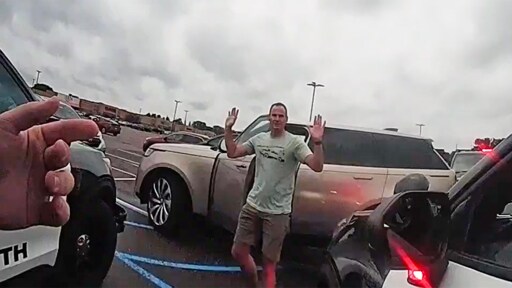
A brief recap: a few weeks ago I’d taken the $155,000 Range Rover I was testing out to run some errands with my wife in Plymouth, Minnesota. I was backing out of a parking space in front of my local Kohl’s when four cop cars came screaming up and “initiated a box and pin on the vehicle,” as the police report says. Hands on their guns, the officers ordered us out of the vehicle, patted us down, and eventually told us the Range Rover’s license plate—New Jersey 34 10 DTM—was stolen, they suspected the vehicle itself was stolen too, and they’d used Flock cameras to track me down over the last two days.
The scenario involving my wife and I is just one of many like it. Thomas noted that the system is 99% accurate today, but it’s performing 20 billion reads a month. That 1% error rate, of which I was a part of in June, makes for two hundred million misreads a month.
Of course. Flock always works correctly, even when it causes innocent people to get harmed.
Its a spying tool first and foremost, the crime solving part is just a half-arsed afterthought justification.
It makes me wonder if politicians, celebrities, etc. have their plate numbers already entered into Flock as a whitelist of people not to pull over.
The story makes it pretty clear that the cops are, as usual, not doing any independent thinking. The system says to pull that car over, so they do what the system wants. They don’t double-check to see if what the system is telling them to do is reasonable. If someone fat-fingers some data entry and the plate for the governor of California gets added to the system, the cops might charge up and box him in and jump out with their guns drawn. That might result in someone with actual power getting mad about Flock. So, maybe they prevent that by pre-loading the system with a whitelist of plates that are assumed to be in the clear.