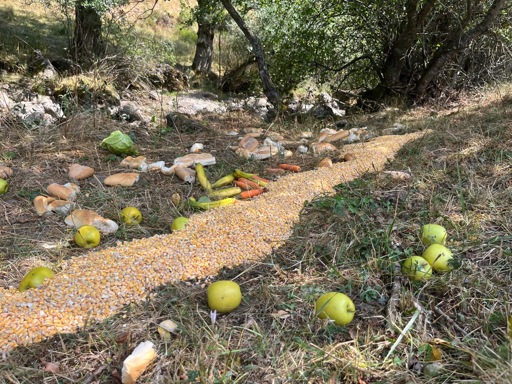
La acción del partido animalista PACMA, que ha repartido varias toneladas de comida en las zonas afectadas por los incendios en Castilla y León, abre el debate acerca de qué podemos hacer en un bosque calcinado para favorecer su recuperación.
Every morning, Hector picks up his bike and goes to the bush. To what’s left of him. Héctor is 15 years old and is a neighbor of Vilardevós, one of the many municipalities in the province of Ourense that have seen their land burn in one of the worst waves of fires that are remembered. Among the ash, Héctor searches for footprints, traces of animals that can continue to live in the burned forest. It does so by reviewing the surroundings of the water sources that have been cleaned and rehabilitated from the Rural Development Center (CDR) Portas Abertas de Vilardevós and also some points where they have left some food.
At the moment, there is no trace of animal life. And that’s good. “Here we were lucky that of the 15,000 hectares of mountain that is in the municipality, about 4,000 burned, so there are still many green areas in which the animals are probably taking refuge and feeding,” explains Tamara Balboa García, coordinator of the CDR Portas Abertas and neighbor of the village of Vilardecervos. “We saw wild boars come out of the fire, we saw the roe deer escape. Those animals are now going to be where they feel protected and have food. They are not going to stay in a burned forest in which they are totally exposed.”
Once the emergency has passed and most of the outbreaks of the great wave of fires that during the month of August left more than 380,000 burned hectares in Spain, there have been many people who have looked at the mountain looking for something to help in which to help : how to make the forests recover their life soon, how to help farmers to feed their extensive herds that have been left without grasses, how to make the animals not without food
Some of these actions, such as the one announced by the animalist party PACMA, which has distributed several tons of cereal, feed, fruit and vegetables to feed the animals from the affected areas of Castilla y León, raised some controversy in networks. Despite the good intentions, sometimes some actions can eventually bring more problems than benefits to wildlife and ecosystems.
“Deer, for example, feeds on leaves, tender shoots, tree bark or shrubs, pastures, mushrooms, nuts… But corn and feed are not among their food. If suddenly we give them a lot of them, we are going to generate many digestive problems and surely end up developing diseases,” says Víctor de León Hernández, a biologist at the forestry NGO Fénix Canarias. “The same thing happens with wild boars. Their real diet does not fit with what we see being contributed to them in actions like the one in PACMA.”
For the biologist, it is most likely that the large amounts of food spread across the burned forest will end up rotting (as the animals, if they can, will seek shelter elsewhere where they are less exposed). This can affect the recovery of the soil, which is very degraded by the fire, and can even end up attracting animals more typical of urban environments and accustomed to that food, such as rats, which are not usual of the forest.
In addition, there is a risk of altering the behavior and dynamics of the groups of wild animals, also causing them damage. “The food that has been distributed will last a week or two. There will come a time when the animals that come to eat it and stay in the vicinity of this food source are seen in a place without any recourse. While they are there, they will not be looking for new shelters or new sources of food in the wild,” adds Víctor de León.
After a fire, what can be done?
“Animals usually return to their landmarks. So the first thing we did once the fire went out was to clean up the water points that we had identified and that were full of burned branches and ash. We also enabled some extra drinking trough, in collaboration with the hunting ground, making sure they had water and were clean,” explains Tamara Balboa García. “We also left some food, but especially with the idea of knowing if there was life in the environment or if they had left. In our case, we have not seen significant movements, but in other municipalities more affected it has served to detect animals.”
According to Víctor de León Hernández, in the case of distributing food in the bush after a fire, the ideal is to do it in small quantities and leave food that is collected from other nearby forests, such as berries, branches and leaves, that imitate the usual diet of the species that we want to feed. “Although it is difficult and not everyone has the technical means, it is best to place phototrapping cameras to know what animals are left in the environment and know what they are facing, so we can help them better in case they need assistance,” adds the biologist of Fénix Canarias.
Despite what may seem, food is not the priority when it comes to helping what remains of the forest ecosystem after a fire. “The most immediate actions have to be oriented, in a general way, to hold the ground, which has remained naked and is covered with ash. That is, we have to avoid that, when it rains, the water drags the little organic matter that remains in the soil. It is best to build fajinas, transverse barriers to the slope made with branches and trunks, to slow down erosion, “adds the biologist.
With wildlife, the most urgent thing is to rehabilitate the water sources that may have been damaged by the fire, as they did for example in the Rural Development Center Portas Abertas in Vilardevós. “We were surprised at the amount of water that the mountain still has, despite the hot and dry summer we wore. We are lucky that in winter it has rained so much and that the forest has retained all that water,” says Tamara Balboa García.
All these interventions to assist wild animals must be punctual, since it is important not to alter the behavior of the species. Whether or not the vegetation recovers quickly, the animals have the necessary tools to look for alternatives and adapt to the new situation. “In the recovery of an ecosystem as degraded as the one left after a fire, wildlife is the last thing that is incorporated. That is why it is not ideal to try to strengthen this fauna in burned areas where they will not find that eating in a long time and where they will devour how little it will grow, “concludes Víctor de León Hernández. “Actions like PACMA’s are born from absolute respect and devotion to animals, but they are not as focused as possible.”
Gracias
¡Un artículo maravilloso! Gracias por compartirlo.